nod.

Your agents are fast. Your clients are the bottleneck.

Nod asks your client one question at a time, in their words, with the cost of each answer written down. They answer in about twenty seconds. Your agent gets the answer back and carries on.

Ask for a link Invitation-only while it is young.

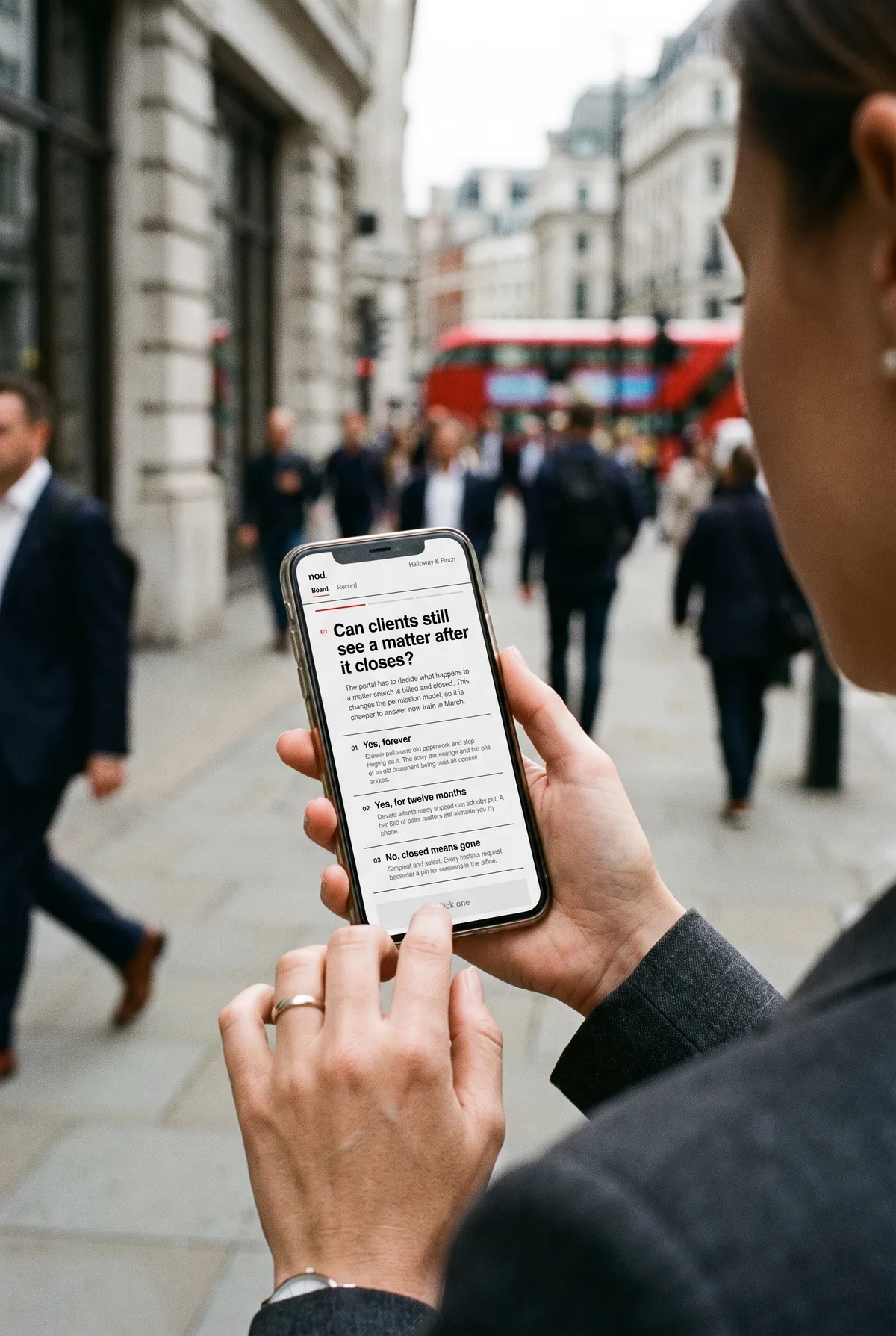
A managing partner stopped on a busy London street, reading one question on her phone while commuters blur past

Twenty seconds, between meetings. That is the whole thing your client has to do.
01How it works

Get your answer in seconds, not next Thursday.

One question, two to four answers, each with its cost written down. Your agent raises the call. Your client answers it. Nobody writes a status update.

01Your agent hits a fork only the client can settle.
02It raises a call: twelve words, two to four answers, each with its cost.
03Your client nods one, from the app, the lock screen or a text.
04The answer goes back as the agent's next instruction, and it is written down for good.

The call on the right is the real thing, not a picture of one. This is what your client sees. Answer it.

03

Late cancellation, do you keep the money?

Whatever you pick goes on the booking page in plain English, so it has to be one you will defend.

Nodded.

What happens now
The booking page says it in plain English by tonight, and the three customer texts get rewritten to match.

That took eight seconds. The agent had been sat waiting on it since Tuesday.

02The cost of waiting

Stop building the wrong thing while you wait.

You have built it twice because nobody would answer. The model is not what slows you down, it is the fifteen small decisions a week that only the client can make, and every one of them arrives when they are with a customer.

So you guess and rebuild it next week, or you write them a paragraph on WhatsApp that they read on Thursday. Either way the branch sits there, and you are the one who looks slow.

03Who it is for

For the people who ship other people's software.

Agencies building with AI

Four projects running, four owners who answer when they feel like it. Put each of them on their own board and stop being the middleman.

Freelance developers

You are the developer, the project manager and the person doing the chasing. Nod takes the third job off you.

CTOs and product leads

Your decision-maker is down the corridor rather than on a client call, and no easier to pin down. Same problem, same twenty seconds.

04What your client gets

Nothing for your client to learn, so they actually answer.

No portal to log into, no board to keep tidy, no password to lose. The desktop view adds the queue for the weeks when there are five calls waiting, and answers from the keyboard.

Over the shoulder of a client holding her phone: one call at full height, a big black question and three answers with their costs

One call. No list, no tabs, no scrolling to reach the answers.

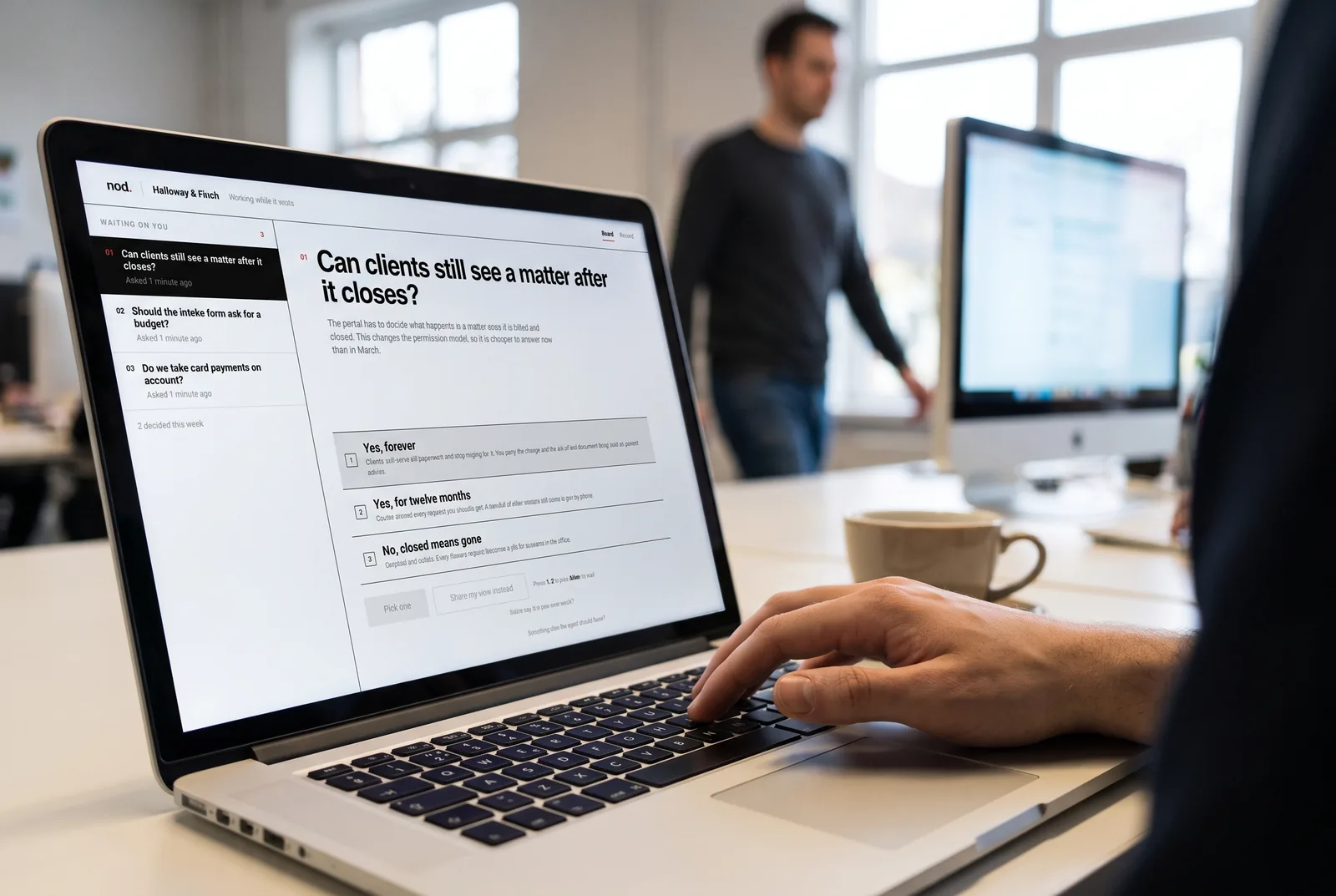
A developer's laptop showing the desktop board: queue down the left, one call at full size on the right

Press 1 to 3 to pick, Enter to nod. The mouse is optional.

Questions land on their lock screen, or in a text.

They should not have to open anything, so a call arrives where your client already is. Nothing to install, no account to set up.

A clinic director at a busy reception desk, glancing at a question on her phone between patients

Answered from the lock screen, without unlocking into an app.

A fleet operations director crossing a depot forecourt of white vans, thumbing a reply on his phone

Or a reply to a text, the same as they answer everyone else.

05Why they answer

Four rules that make answering easier than ignoring you.

Clients who ignore your emails answer this. Not because of the screen, because of what the screen refuses to do. A call that breaks these rules is rejected before it ever reaches them.

12
words, maximum
If it cannot be asked in twelve words it is not one question yet. It gets split in two.
2–4
answers, never five
More than four and they are doing your agent's thinking for it. Fewer is usually better.
Every
answer states its cost
"Loses about one booking in twenty." No downside hidden, so they can decide in seconds.
0
jargon, ever
No deploys, no configs, no issue keys. Your client never sees a branch name.
06The record

Scope arguments end in about four seconds.

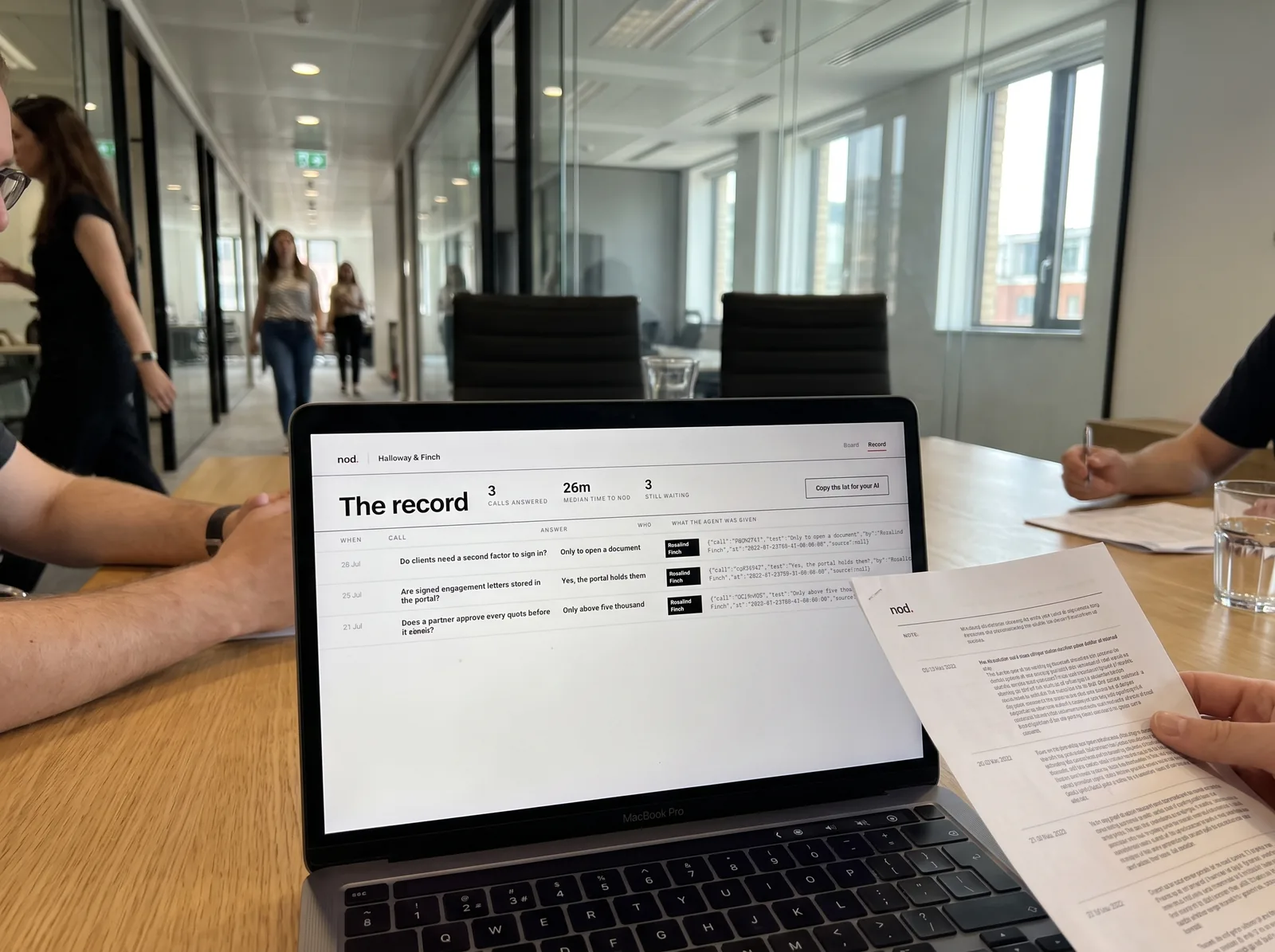
Every call is kept: the question, what they chose, what it was going to cost, who settled it and when. So when somebody says they never agreed to that, you send them the line with their own name and the date on it.

Hand the whole history to your agent in one tap and nothing gets re-litigated six months later.

A laptop on a meeting-room table showing the record: a dated table of answered calls with who decided each one

The receipt. Dated, attributed, in the client's own words.

07Wiring it up

Your agent asks, then waits, instead of guessing.

Nod is an MCP server at nod.stumason.dev/mcp. Point any agent at it with a project token and it gets three tools: ask, get_call and list_calls. The twelve-word limit and the cost-per-option rule are enforced at the door, so a badly framed question never reaches your client.

Which client it belongs to, which repo, which issue: all of that stays on your side of the wall. Your client sees a question and three answers.

# your agent, mid-branch
ask(
  question: "Late cancellation, do you keep the money?",
  options: [
    { label: "Keep the lot", cost: "A few will grumble." },
    { label: "Keep half", cost: "The usual middle." },
    { label: "Give it all back", cost: "About £40 a month." }
  ]
)
# later: get_call → "Keep half", Rosalind, 09:41. Carry on.
08What it deliberately isn't

No features that turn a decision into homework.

Every one of these has been asked for, and each would turn a decision back into a task, which is the thing your client already refused to do.

No statusesAnswered, or not.
No due datesIt shows what is stopped instead.
No comment threadsIf it needs discussing it is not a call.
No backlogOnly what is blocking work right now.
No votingOne named person decides.
No dark modeIt is not a tool for developers.

Want it on your builds?

Nod is invitation-only while it is young. Tell me what you are building and who has to answer for it, and I will send you a link.

Already been sent one? It signs you straight in. There is no password to remember.

Ask for a link